
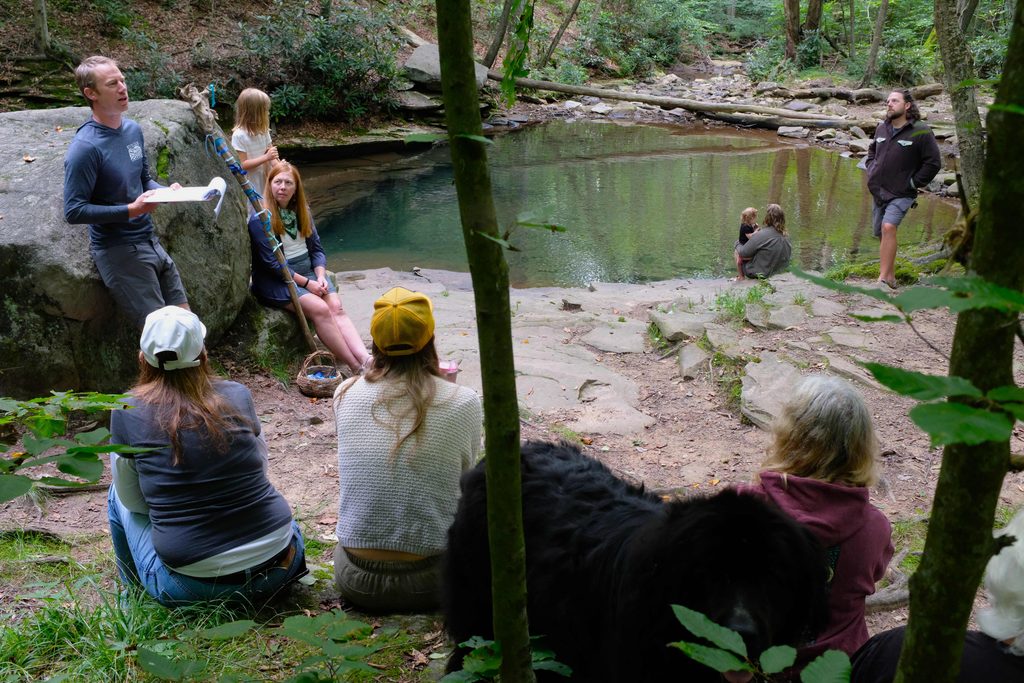
In early August, MWA staff and community members gathered at a beloved local swimming hole. The day was warm and tropical, the water clear and inviting. The creek burbled over damp rocks, tumbling over a stony slide into a deep blue pool. But none of us were there to swim. Instead, we had assembled to process the loss of the swimming hole on Blue Hole Creek.
It has been over a year since the community at large learned that something has changed at Blue Hole, something was very wrong. At first it was the blackened moss, the bleached rocks, the foamy accumulation on the upstream sides of logs. Testing revealed the magnitude of the situation – the headwater tributaries of Blue Hole are so badly polluted that they were spewing dangerous levels of heavy metals into the creek that feeds the Laurel Highlands’ most beloved watering hole.
Through extensive sampling, investigative advocacy, and grappling for the answers from the state, Mountain Watershed and our community learned that the headwater tributaries of Blue Hole Creek had been contaminated with high lead concentrations coming from an overaccumulation and improper handling by a shooting range, Highlands Sporting Clays, which operates on the land directly above the creek’s headwaters.
At that point we learned that the PA Department of Environmental Protection (DEP) had been aware of this issue for over a year! We filed a complaint with DEP and received a response indicating that DEP’s Solid Waste Dept had responded to the issue. But the operator still hasn’t received any meaningful reprimand from the Department.
Over a dozen residents attended the gathering. Stacey Magda, MWA’s Director of Advocacy, and Eric Harder, our Youghiogheny Riverkeeper, presented an overview of the pollution and its broader implications for the creek.
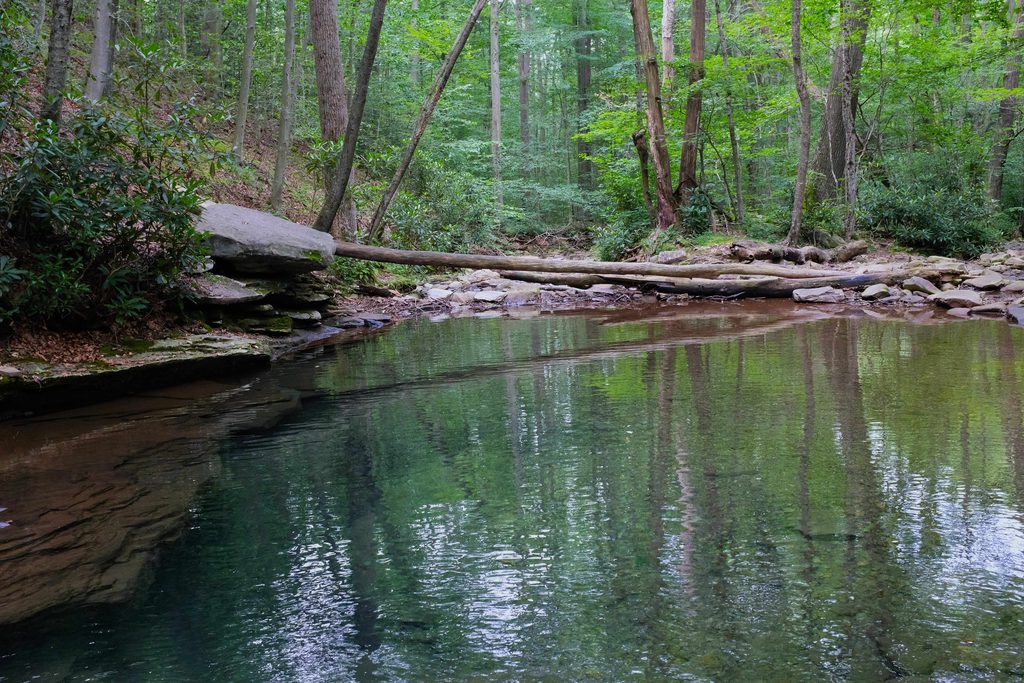
Why is Blue Hole Creek so important? This waterway was considered an Exceptional Value stream, the highest level of cleanliness and biological value. It had habitat for lots of beneficial stream bugs and our native Brook Trout, which thrives in only the cleanest, coolest waters. The stream is also an important waterway for hikers on the Laurel Highlands Hiking Trail. Backpackers may have been accidentally filling their bottles with lead-contaminated water for years (most hiking filters cannot remove lead in acidic water).
Are lead levels still high? Yes – lead levels near the Laurel Highlands Hiking Trail are 372 ppb as of our most recent sampling
What is Highlands Sporting Clays doing? We have reports that they are starting to treat lead-contaminated soil at the site.
What has PA DEP done? DEP issued a Notice of Violation last year – a letter stating that Highland Sporting Clays caused lead contamination in the creek. However, DEP has not issued a Consent Order, which is an enforceable document outlining exactly how the site should be cleaned up.
Is it safe to swim? More testing is required. Our concern is that the lead could fall out of solution as the water runs downstream over rocks (bubbling water is less acidic, which causes lead to form a solid). We don’t know exactly where the upstream lead ended up – it could be in the riverbed or in the soil around the creek.
Is lead bad for the creek? Yes. Lead harms aquatic life and disrupts reproductive cycles. Lead also “bioaccumulates,” which means that it builds up in the bodies of aquatic organisms and gets worse as it moves up the food chain to birds and mammals that eat fish.
What can we do about it? Sign onto our letter campaign, and share it with your friends and neighbors. This is the most powerful tool we have at the moment to convince the PA DEP to take stricter measures against the polluter.
–
More than just a call to action, this event was a chance for our community to come together and share the grief of losing Blue Hole Creek for yet another summer. The term “ecological grief” has become popular to describe these feelings – it refers to the sense of loss that arises from experiencing or learning about environmental destruction or climate change. This is our current reality. As a community, we have to acknowledge that grief.
If that resonates with you, please take some time to reflect on the situation at Blue Hole Creek, and to hope for a future where our waters are clean and welcoming again. This land is not forsaken – it just needs our help.