
The Sewickley Township Board of Supervisors in Westmoreland County approved a new ordinance governing data centers at its meeting on July 15, 2026. This ordinance creates local control over how and where data centers can be built.
The ordinance adds data centers to the Township’s zoning regulations and allows them as a conditional use in the Manufacturing and Technology (M-T) zoning district. This means a proposed data center must go through a local review process before it can be approved.

Why Does Local Zoning Matter?
Zoning is one of the main ways a local government can plan for new development and growth. It helps communities decide what types of development belong in different areas. For example, industrial farms, businesses, and factories can all have different impacts on nearby homes.
Additionally, zoning keeps incompatible activities out of the same areas. A rural township may have different roads, water supplies, and natural resources than a large city. Zoning allows local officials to take these factors into consideration when approving, denying, or requesting a change to an application.
A conditional use process creates an opportunity for local officials to examine the project, hear from the public, and decide whether the proposal fits the community. Without a zoning ordinance, local governments do not have much control over whether, where, and how a data center is built.
Sewickley Township’s Ordinance
Sewickley Township’s ordinance allows data centers as a conditional use in the Township’s Manufacturing and Technology (M-T) zoning districts. This means a data center cannot simply be built anywhere in the Township. A developer must apply for approval and show that the project meets specific requirements. Then, the Township’s Board of Supervisors makes the final decision after review by the Planning Commission, Township professionals, and the public.
The rules cover many parts of a data center project. For example, the ordinance sets requirements for building size and location, parking, loading areas, noise, safety, emergency response, water use, electricity, stormwater, environmental impacts, traffic, and landscaping.
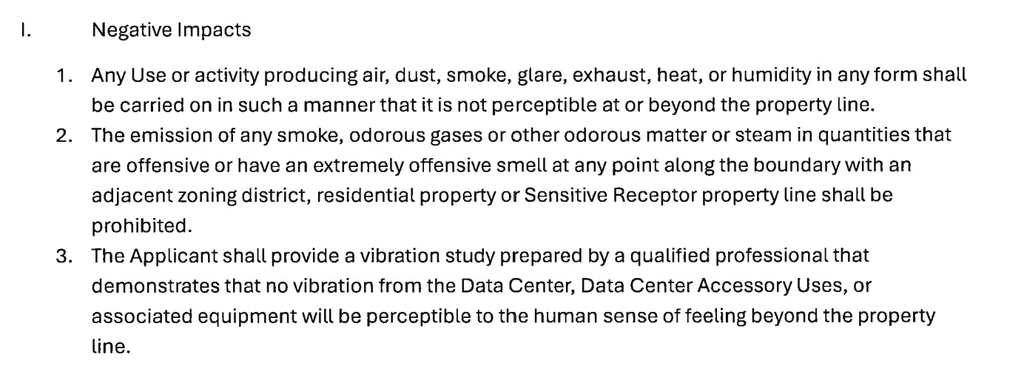
The Ordinance also regulates noise: permittees will be required to submit professional sound studies during the approval process, during construction planning, and after the facility opens. It also sets limits on noise, along with stricter protections for nearby homes, schools, health facilities, and other sensitive receptors.
The ordinance also addresses water and energy use. Developers must study the amount of water a facility will need and show that the project will not harm nearby wells or other water supplies. Data centers are expected to use “closed-loop” cooling systems unless another system can be shown to use less water and energy. The ordinance also includes requirements related to electrical capacity and energy efficiency.
Safety and emergency planning are another major focus. Data centers that use battery storage must meet fire-safety standards, and applicants must prepare an emergency response plan. The plan must address issues such as fire suppression, evacuation, emergency access, and communication with local emergency responders.

Additionally, applicants must provide studies of traffic, environmental impacts, stormwater, air pollution, and nearby natural resources. Projects near streams, wetlands, floodplains, or other sensitive areas face additional requirements. New data centers must also provide buffers and screening when they are next to certain residential or agricultural zoning districts.
Finally, the ordinance addresses what happens if a data center stops operating. Developers must prepare a “decommissioning” plan, explaining how the facility will be removed, and how the land will be restored. The ordinance also requires financial security to help cover those costs if the owner does not complete the work.
Zoning is important because it helps communities shape how land is used and protects the character, safety, and quality of life of local neighborhoods. Through zoning, communities can guide development, protect resources, and ensure that new projects fit the needs of residents. If you have concerns about future development in your community, consider reaching out to your local officials about zoning options. There are many ways to use local zoning policies to help protect the places and qualities that are important to your community.