Data centers have been all over the news lately, and for good reason. Hyperscale facilities can be loud, stinky, and can use up as much energy as a small city. While data centers themselves are troubling, many don’t realize that they often also necessitate a buildout of new infrastructure. Transmission lines are used to connect the centers to the massive amount of energy required, and a few are already proposed to cut right through rural properties in Pennsylvania and other parts of the Youghiogheny River watershed. While they haven’t been approved by state agencies yet, it is important to know your rights as a property owner as these transmission projects move along.
At the moment, there are three transmission lines proposed in the Youghiogheny River watershed. The Mid-Atlantic Resiliency Link, or MARL, is a 107-mile line from Northern West Virginia to Loudoun County, Virginia. MARL is a project by Florida-based NextEra Energy, and is the line which is farthest along in its application process. MARL is proposed to cut through parts of Greene and Fayette Counties before heading back south into West Virginia and Maryland. For MARL, NextEra has submitted applications to become a public utility. Public utility status would enable NextEra to take property from landowners who refuse to lease through eminent domain.
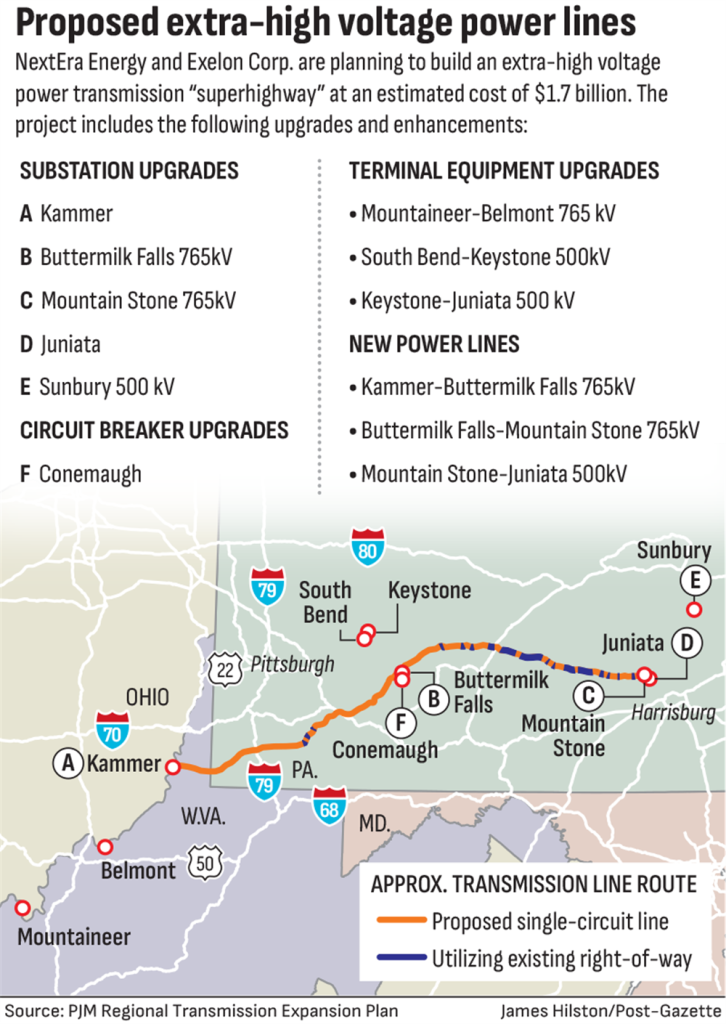
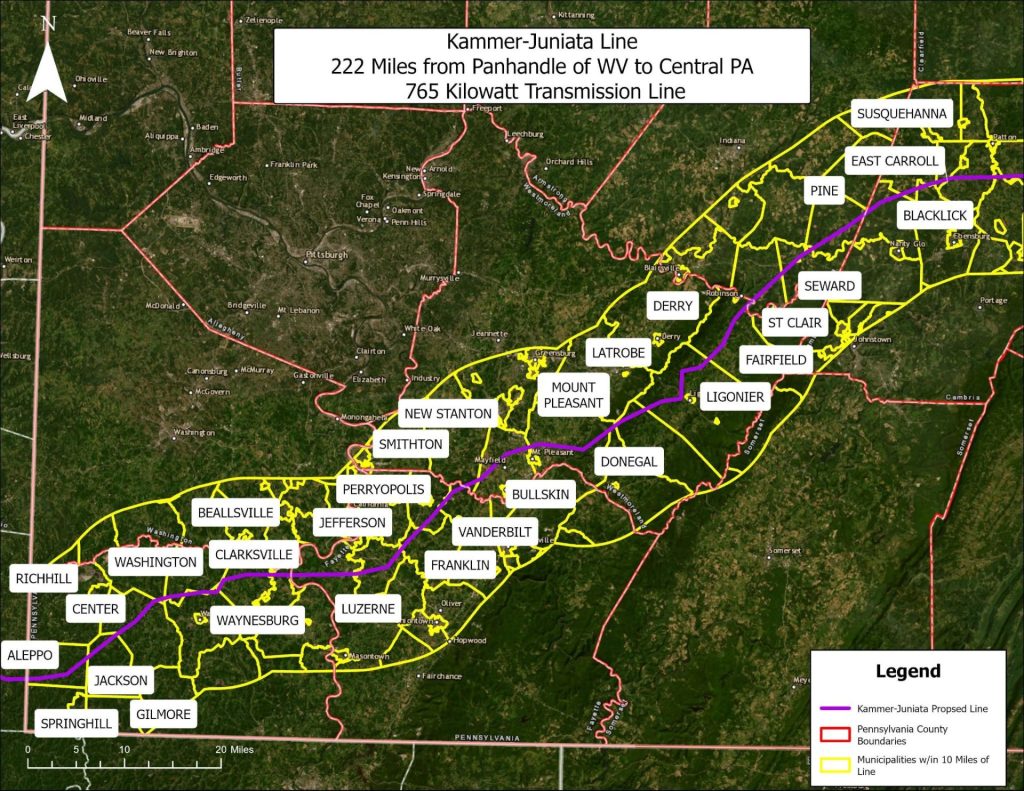
NextEra Energy also hopes to build the Kammer-Juniata line. Kammer-Juniata would stretch 220 miles from Northern West Virginia to Central PA. NextEra has only submitted preliminary filings to the Federal Energy Regulatory Commission (FERC) at this point. No final route has been proposed yet, but based on a conceptual map released by NextEra and the endpoints of the proposed line, Greene, Fayette, Westmoreland, Indiana, Cambria, Blair, and Huntingdon Counties could all be affected. A third line— the Valley North Project by Transource— is proposed to cut through northern West Virginia and western Maryland. The Valley North line is not currently proposed to cut through Pennsylvania, but it is proposed to pass through the Youghiogheny’s headwaters.
Using what we’ve learned from talking with property owners in MARL territory and folks at the Pennsylvania Office for the Consumer Advocate, we know that once FERC finishes its review, land agents may begin to visit the area. These land agents will be asking for easements to begin surveying properties. For the MARL line, community members have reported land agents traveling to property owners’ primary residences, as far out of the way as Pittsburgh, to try and obtain these easements.
NextEra has not yet received its Certificate of Public Convenience from the state, so they do not have the right to enter your property without your consent. If and when they do obtain a Certificate of Public Convenience, they may survey your property without your permission, but only after providing you with 15 days notice (subject to the exceptions listed in 57 Pa. Code § 57.91) There are reasons that they can visit your property without a certificate of public convenience or any notice, including to make an attempt to establish contact with the owner, to request permission to survey the property, or to request an easement.
Around the same time as land agents begin coming around, NextEra will likely begin to file applications to state public utility agencies in WV and PA. At this stage, NextEra will submit a more robust route, including alternative route options. The Pennsylvania Public Utility Commission (PUC) will then review the application, considering a few different criteria. For PUC to approve a line, they must determine that there is a need for the project, that it will not put the public at unnecessary risk, that it will comply with the PA Constitution’s Environmental Rights Amendment, and that there will be a minimal adverse environmental impact.
This stage of the process also opens a few doors for public participation. Once the PUC application has been submitted, there will likely be public input hearings along the proposed route, where residents will have an opportunity to provide testimony. These hearings usually take the form of a bus traveling from site to site, taking testimony individually from folks along the proposed route. At these hearings, people have the opportunity to provide oral testimony to put their concerns on the public record and include them in the PUC’s review.
There are a few other ways for concerned parties to participate in the application process. You can file a formal protest once a siting application has been filed with the PUC, which makes you a “party of record” in the case. This means you will receive all discovery, testimony, motions, and other legal documents associated with the case. Protests must include a statement of your interest in filing the protest, the grounds of your protest, and facts or evidence supporting the grounds of your protest. Complete instructions for filing an official protest can be found at 52 Pa. Code, Sections 5.51, 5.52, and 5.53.
You can also submit a petition to intervene. Intervenors may be able to choose the level of participation that fits their capacity, but the judge overseeing the case has the ultimate say. Depending on the level of commitment, ‘active’ parties may have to participate in discovery and regular court proceedings. Intervenors can be as small as private residents along the route or as large as municipal or county governments, but depending on whether an intervener is an active or inactive party, they may need to participate in discovery, provide testimony at evidentiary hearings, and face other kinds of legal exposure. Individuals who intervene can represent themselves, but non-individuals are required to be represented by an attorney.
The easiest thing community members can do is submit an informal objection letter. Letters of protest to the PUC allow people to voice their concerns without involving themselves in courtroom proceedings. These letters can follow the same structure as a formal protest, and should include the name of the case and docket number. They should also be mailed to the PUC’s Secretary at the following address:
Matthew Homsher, Secretary
Pennsylvania Public Utility Commission
Commonwealth Keystone Building
400 North Street
Harrisburg, PA 17120
Transmission projects like MARL, Kammer-Juniata, and Valley North are being proposed left and right across the country, and are funded partially through regular people’s utility bills. A report by the Institute for Energy Economics and Financial Analysis looked into how the West Virginia segments of MARL would be paid for, and estimated that residential ratepayers in West Virginia would contribute about $195 million to the projects, which has already doubled in its forecasted cost since its proposal.
Corporations like NextEra and Transource claim that transmission projects are necessary to serve growing electricity demand, but without data centers in the first place, none of these lines would be needed. If you are curious to learn more about transmission lines in the watershed, Transource is hosting a series of open houses throughout the region, two of which are in the watershed:
- Garrett County, MD
- July 15th, 2026— 4:00-7:30 PM
- Southern Garrett County High School
- 345 Oakland Drive, Oakland, MD 21550
- Preston County, WV
- July 21st, 2026— 4:00-7:30 PM
- Craig Civic Center
- 311 Tunnelton Street, Kingwood, WV 26537