On March 20, 2025, residents of the Mon Valley, regional environmental groups, attorneys, and scientists gathered in the Rostraver Fire Hall to provide public comment on Westmoreland Sanitary Landfill’s most recent attempt to deal with their longtime leachate issues: a NPDES permit that, if approved by the PA DEP, would allow them to dispose of allegedly treated leachate directly into the Mon River.
Almost 100 people packed the firehall, with 20 speaking out against the proposed plan. Speakers addressed a wide range of concerns with the current draft as well as a legacy of noncompliance and negligence.
Community members provided sobering testimony about the grim realities of living near the landfill, citing unusually high incidences of rare cancers in areas adjacent to WSL’s property, respiratory conditions and poor air quality, and presence of heavy metals such as lead in drinking water, a metal for which there is no safe amount of exposure.
Environmental scientists, public health professionals, and doctors echoed these concerns and identified numerous deficiencies in the draft permit, deficiencies that indicate an inability to assess and regulate radioactivity and PFAS (a group of toxic, man-made chemicals) in a way that would keep the community safe.
To understand the full scope of the issue, let’s dig into the history of Westmoreland Sanitary Landfill and what exactly this NPDES permit is proposing.
A History of Noncompliance
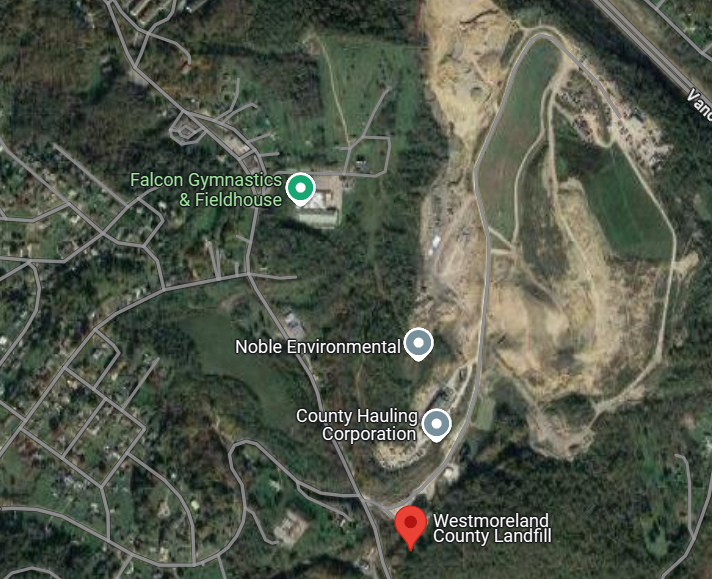
Westmoreland Sanitary Landfill (WSL) is located in Belle Vernon, PA. It’s operated by Noble Environmental and accepts everything from municipal waste to friable asbestos, industrial waste, contaminated soil, and drill cuttings from fracking waste. The landfill looms over shopping centers, neighborhoods, restaurants, and a local gymnastics center where thousands of children attend weekly lessons.
WSL has a legacy of mismanagement and negligence and is currently operating under five DEP Consent Orders, which cite violations of their existing permits, the Solid Waste Management Act, Waste Transportation Act, and Clean Stream Laws. Consent Orders are agreements between DEP and a permitted facility that acknowledge laws or permits were violated and action steps will be taken to correct the issues.
Many of these consent orders address WSL’s mishandling of toxic leachate. Leachate is formed when rainwater filters through wastes placed in a landfill. When this liquid comes into contact with waste, it leaches, or draws out, chemicals or constituents from those waters.
WSL has been struggling to manage their leachate since at least 2010. Currently, WSL trucks their leachate offsite, but prior to this they attempted an array of strategies to dispose of it, including piping it through Belle Vernon’s sewage treatment plant. Municipal sewage treatment plants are not equipped to handle constituents such as PFAS and radioactive substances, and the toxicity of the leachate impaired the plant itself.
Despite WSL’s efforts to move waste offsite, they can’t keep up with the amount of leachate produced and are seeking alternative solutions. In 2024, WSL applied for a permit for a leachate evaporator, which was defeated by the community and local environmental organization, ProtectPT.
Now WSL is proposing to construct a leachate treatment system on their property that will discharge into the Monongahela River, potentially contaminating drinking water for millions of people.
What’s up with this NPDES permit?
NPDES stands for National Pollutant Discharge Elimination System. Created in 1972 by the Clean Water Act, these permits are intended to address water pollution by regulating point sources that discharge pollutants into waterways.
There are many concerns with WSL’s proposal. As it stands, the permit does not contain limits on PFAS, radiologicals such as radium, heavy metals like lead, chromium, and zinc, and common man made organics such as benzene and toluene. In addition, WSL’s allegedly treated leachate exceeds acceptable permit standards for multiple pollutants.
Gillian Graber, executive director of Protect PT, said, “We are deeply concerned about their ability to adequately treat their leachate so that the Monongahela River is not impacted.”
The Mon, which flows north towards Pittsburgh where it joins the Allegheny to form the Ohio, is already impaired for sediments, metals, low oxygen, chemicals, and abnormal flow. Any further pollutants that enter the river could set the Mon back, rendering years of remediation and cleanup efforts waste.
“The landfill has a known issue with compliance and not containing their toxic waste within the landfill,” said Heather Hulton VanTassel, executive director of Three Rivers Waterkeeper. “We need stricter permit regulations and meaningful enforcement of violation to the Clean Water Act to prevent future pollution and harm.”
It may be possible that leachate from WSL has escaped into abandoned coal mines beneath the facility. This underground network of mines could convey toxic waste far from the property boundaries of WSL and into the surrounding watersheds, including the Youghiogheny River.
And WSL isn’t the only landfill built over subsurface mines in proximity to the Yough. Nearby MAX Environmental, located in Yukon, PA with a discharge into Sewickley Creek, also sits above an abandoned mine void that may convey hazardous pollutants into our watershed.
Eric Harder provided comment on behalf of Mountain Watershed Association. He raised concerns about Total Suspended Solids, PFAS, emphasized the need for stricter regulations and inspections by DEP at the site, and urged DEP to come up with a safe, protective solution for fracking waste that competently manages the problem without harming public and environmental health.
What can you do?
DEP will continue accepting public comments on WSL until April 3rd. You can either mail your comment to DEP or send it by email. If you would like support in writing your comment or would like to learn more about the longstanding issues at this facility, please reach out to Sara Majorsky at ProtectPT (sara@protectpt.org).
Email: RA-EPNPDES_SWRO@pa.gov
Mail: DEP Southwest Regional Office ℅ Clean Water Program, 400 Waterfront Drive, Pittsburgh, PA 15222